On April 21, 2026, CATL held its Super Technology Day new product launch event in Beijing, officially unveiling the third-generation Shenxing Superfast Charging Battery, the third-generation Qilin Battery, the Qilin Condensed Matter Battery, the second-generation Xiaoyao Super Hybrid Battery, the Naxtra Battery, and the integrated super charging-swapping all-scenario energy replenishment network plan, providing more diverse and efficient new energy solutions for different travel scenarios and user needs.
The third-generation Shenxing Superfast Charging Battery once again set a global record for power battery charging rate, needing only 6 minutes to reach full charge at room temperature, achieving a perfect balance between extreme rate capability and ultra-long life; the third-generation Qilin Battery achieves an energy density of 280Wh/kg, easily delivering a 1,000-kilometer range, making it an ideal choice for high-end new energy electric vehicles that balance long range and lightweight design; the Qilin Condensed Matter Battery pushes range to 1,500 kilometers, further achieving a new breakthrough in driving range; the second-generation Xiaoyao Super Hybrid Battery delivers 600 kilometers of pure electric range, opening a new checkpoint in the hybrid track; and the Naxtra Battery will drive the sodium-ion material system from technological breakthrough to large-scale mass production.
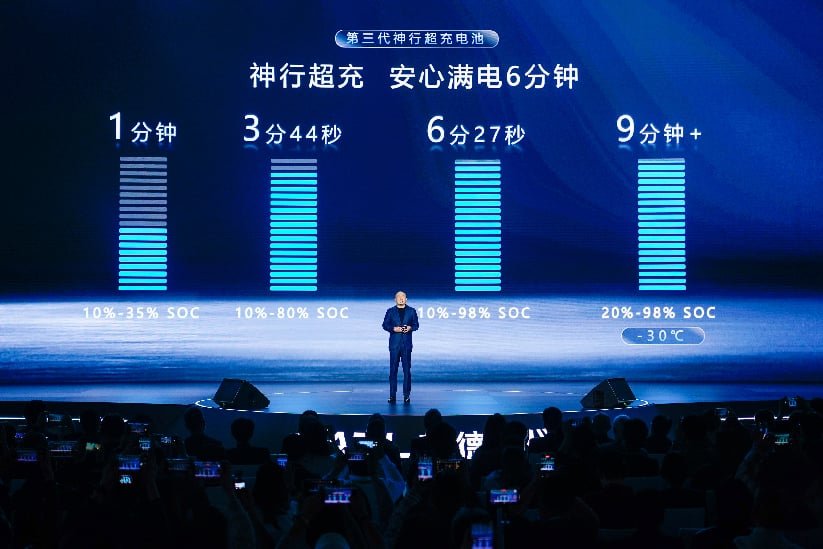
Third-Generation Shenxing Superfast Charging Battery: No Longer Choosing Between Superfast Charging and Ultra-Long Life
From an electrochemical mechanism perspective, to achieve improved charging rate without compromising battery life, the core challenge is not trickle charging, but temperature rise. According to the Arrhenius equation, for every 10°C increase in battery temperature, the internal side reaction rate approximately doubles, greatly affecting lifespan.
The third-generation Shenxing Superfast Charging Battery, through three major approaches—reducing heat generation, enhancing heat dissipation, and improving precision—maintains a battery capacity retention rate above 90% even after 1,000 complete cycles, achieving compatibility and balance between extreme superfast charging and ultra-long life. The latest third-generation Shenxing Superfast Charging Battery has achieved the industry's strongest superfast charging capability of equivalent 10C and peak 15C, requiring only 1 minute from 10% to 35% SOC, only 3 minutes and 44 seconds from 10% to 80% SOC, and only 6 minutes and 27 seconds from 10% to 98% SOC; in an extreme cold environment of minus 30°C, approximately 9 minutes from 20% to 98% SOC. Combined with battery self-heating technology and the integrated super charging-swapping energy replenishment network, it truly achieves low-temperature superfast charging without being picky about charging piles, and is both chargeable and swappable.
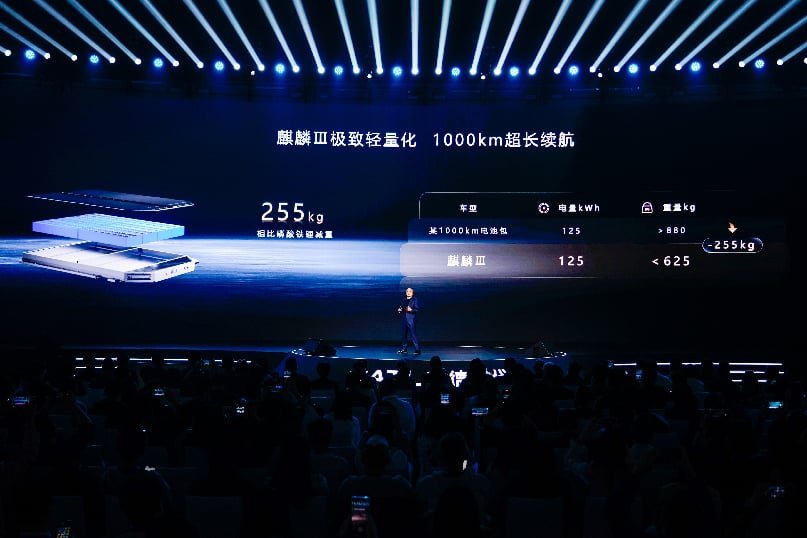
Third-Generation Qilin Battery: Lighter, Stronger, More Premium
In the past, for high-end new energy electric vehicles to achieve long range, the common approach with lithium iron phosphate materials was to stack more capacity, inevitably sacrificing the vehicle's lightweight requirements.
The third-generation Qilin Battery achieves a cell energy density of 280Wh/kg, delivering a 1,000-kilometer range while featuring standard 10C superfast charging, with the battery pack weight controlled at 625kg. Compared with comparable 1,000-kilometer-range lithium iron phosphate models on the market, it reduces weight by 255kg and saves 112L of space.
Excellent lightweight metrics bring very significant benefits to the vehicle. First, in terms of energy consumption, energy consumption per 100 kilometers is reduced by more than 6%, saving approximately 0.78 kWh per 100 kilometers. Calculated at 20,000 kilometers annual driving per vehicle and a scale of 1 million vehicles, annual electricity savings reach 156 million kWh, reducing carbon dioxide emissions by 78,500 tons, equivalent to planting 2.55 million trees and covering 1,250 hectares of green space. In terms of handling and safety, 0-100 km/h acceleration time is shortened by approximately 0.6 seconds, and the dangerous window for overtaking and parallel driving is reduced by 12%; moose test passing speed is increased by 8%, body roll angle is reduced by 6.5%, and extreme hazard avoidance capability is improved by 15% to 25%; braking distance from 100 km/h to zero is shortened by approximately 1.44 meters; according to data from institutions such as CATARC, for every 1 meter reduction in 100 km/h braking distance, the probability of high-speed accidents can be reduced by 8%. In terms of durability, the lifespan of key chassis components is increased by 40%, and tire life is extended by 30%—previously requiring replacement at 30,000 to 40,000 kilometers, now at least 10,000 kilometers more. The saved 112L of space can add at least 18mm of headroom to the cabin, or be used to optimize the vehicle's aerodynamic design.
In terms of performance, the third-generation Qilin features 3MW instantaneous power, doubling the power compared to the second-generation Qilin track battery's maximum power of 1,330kW that competed on the Nürburgring in 2025, and will help more automakers continue to push the limits of electric vehicle track performance.
In terms of safety, building on "NP no thermal propagation," it introduces "thermal-electrical separation" technology—designing an independent sealed exhaust channel for each cell. Even if a cell undergoes thermal runaway under extreme conditions, high-temperature smoke can be directed and rapidly discharged along a dedicated channel, achieving "heat travels heat paths, electricity travels electric paths," cutting off the propagation chain from thermal runaway to electrical runaway at the root, truly achieving the transition from "thermal isolation" to "thermal containment."
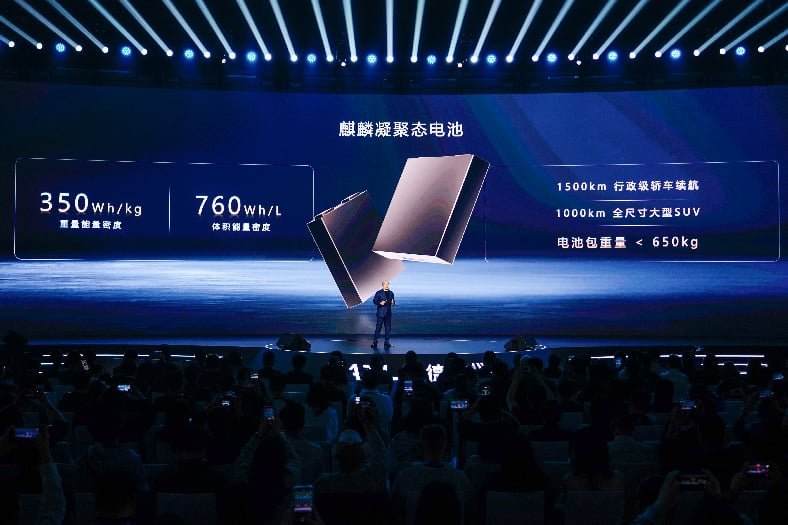
Qilin Condensed Matter Battery: Aviation-Grade Technology Applied to Passenger Vehicles for the First Time
CATL's Qilin Condensed Matter Battery is the first power battery product to apply aviation-grade condensed matter technology to the passenger vehicle sector, with a cell energy density of 350Wh/kg, setting the highest record for mass-produced batteries. This technology was previously developed for the electrification of manned aviation, has completed first-flight verification on 4-ton-class commercial aircraft, and will soon undergo further verification on commercial aircraft above 8 tons.
The Qilin Condensed Matter Battery achieves a volumetric energy density of 760Wh/L. With a typical vehicle battery envelope design, it can enable a sedan to achieve a range of 1,500 kilometers, and full-size three-row, six-seat large SUVs to exceed 1,000 kilometers, with battery pack weight controlled under 650 kilograms. 1,500 kilometers is not just a subversion of fuel vehicles by electric vehicles, but a comprehensive surpassing of yesterday's electric vehicles by today's electric vehicles—from Beijing to Nanjing is about 1,000-plus kilometers, and even with highway range discounted by 30%, it can still be reached in one go.
In terms of safety, the Qilin Condensed Matter Battery upgrades the traditional liquid electrolyte to a condensed matter electrolyte, achieving "no liquid to leak, no liquid to burn" from the source, completely cutting off safety risks that could be caused by electrolyte leakage.
Second-Generation Xiaoyao Super Hybrid Battery: Bringing Extended-Range Hybrids into the 600km Pure Electric Era
The second-generation Xiaoyao raises extended-range hybrid pure electric range to a new height of 600 kilometers, with standard 10C superfast charging across the entire lineup. It also pioneers "Super Hybrid System" technology, covering all extended-range hybrid scenarios from mainstream family use to high-end all-around with three technical routes: lithium iron phosphate, super hybrid, and ternary.
The lithium iron phosphate version of the second-generation Xiaoyao Super Hybrid Battery achieves 500 kilometers of pure electric range, satisfying daily commuting with "one charge per week"; the all-new super hybrid system uses the lithium iron phosphate olivine crystal structure as its core framework, achieving gradient uniform mixing of ternary and lithium iron phosphate at the powder particle level, with an energy density of 230Wh/kg, increasing range by more than 15% compared to a single lithium iron phosphate battery at the same pack weight; the ternary version directly breaks through the 600-kilometer pure electric range threshold, with comprehensive vehicle range exceeding 2,000 kilometers, truly achieving the ease of "one car, two uses."
In terms of power, the second-generation Xiaoyao delivers instantaneous power of 1.5 megawatts at full charge, and still stably outputs 1.2 megawatts at 20% SOC under low battery conditions, completely solving the pain point of "power degradation under low battery" in extended-range hybrid vehicles. Taking a typical hardcore off-road scenario as an example, escaping a desert "chicken nest pit" requires the battery to provide over 350kW of instantaneous power, while Xiaoyao's output power is more than 3 times what is needed for escape—even when battery level is as low as 20% or even below 10%, encountering a chicken nest pit still allows easy escape with one press of the accelerator, delivering a driving experience of "strong performance consistent regardless of battery level."
In terms of safety, the bulletproof-grade bottom coating can withstand 1,500 joules of impact energy, 10 times the national standard (150 joules), equivalent to the shooting power of a standard rifle. Sealing and waterproofing capability reaches continuous immersion in 2 meters of water for over 200 hours with no impact on performance. Whether wading through heavy rain or fording water during off-roading, power remains uninterrupted and safety is uncompromised throughout.
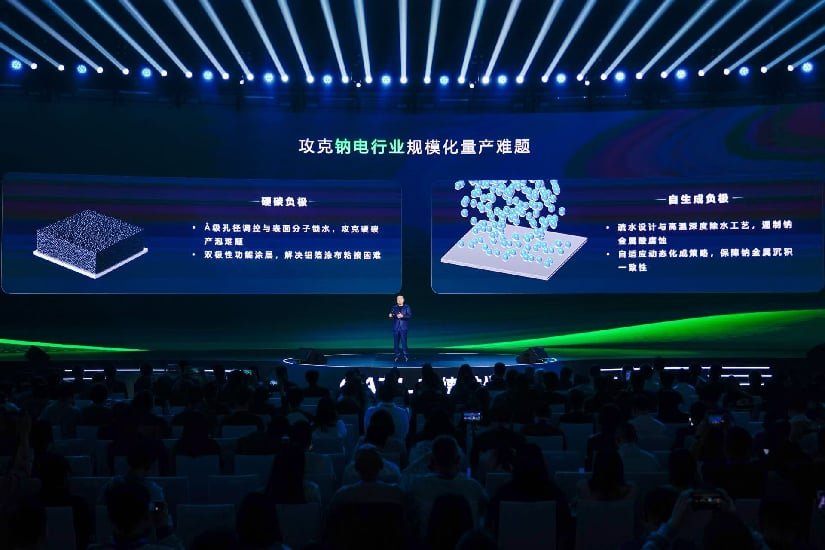
Naxtra: Driving Sodium-Ion Batteries from Technological Breakthrough to Industrial Implementation
This year, CATL broke through four major industry challenges for sodium-ion battery mass production: extreme water control, hard carbon gas generation, aluminum foil adhesion bottlenecks, and large-scale mass production of self-generated negative electrodes, tackling hundreds of engineering problems one by one.
The Naxtra Battery will officially enter large-scale mass production by the end of 2026.
Integrated Super Charging-Swapping: The Optimal Energy Replenishment Form
CATL believes that the future energy replenishment landscape will be divided among home charging, public charging, and battery swapping, with integrated super charging-swapping being the optimal form.
CATL announced that all passenger vehicle "Chocolate" and heavy truck "Qiji" battery swap stations will come standard with Shenxing superfast charging piles, achieving "swappable and chargeable, integrated super charging-swapping linkage."
Integrated super charging-swapping stations share box transformers and charging modules, reducing energy conversion links, with comprehensive electricity loss rate reduced by more than 13 percentage points compared to market battery storage charging stations. When emergency needs arise, battery swap station batteries can be dispatched to discharge to charging piles, achieving equipment reuse rate above 85%. The service capability of a single parking space is 3 times that of battery storage charging stations, and the fixed investment cost of the superfast charging portion is only 1/5 of the latter.
In terms of battery products, the Chocolate Swap Block No. 26 battery was released, featuring an 800V high-voltage architecture, with a first batch 75 kWh version, and larger capacity versions to follow, fully adapting to B-segment to C-segment 800V models. As a result, Chocolate battery swapping will cover the complete model matrix from A0 to C segment.
In terms of network construction, CATL plans to build a cumulative 4,000 integrated super charging-swapping stations by the end of 2026, covering nearly 190 cities and a 12-vertical, 11-horizontal highway network. It will join hands with automakers and energy partners to jointly build a "Super Charging-Swapping Shared Network," with the principles of technology sharing, interconnection, and joint investment. The first batch of partners includes Changan, Chery, GAC, Seres, SAIC-GM-Wuling, and BAIC, with plans to build more than 100,000 shared energy replenishment infrastructure units by the end of 2028.
From five battery products covering the full chemical material system to the comprehensive implementation of the integrated super charging-swapping energy replenishment network, CATL completed a full-chain layout from battery products to energy replenishment infrastructure at this Super Technology Day, driving new energy mobility from "single-point breakthroughs" to "all-scenario coverage," allowing users to find the optimal solution for every travel need.


