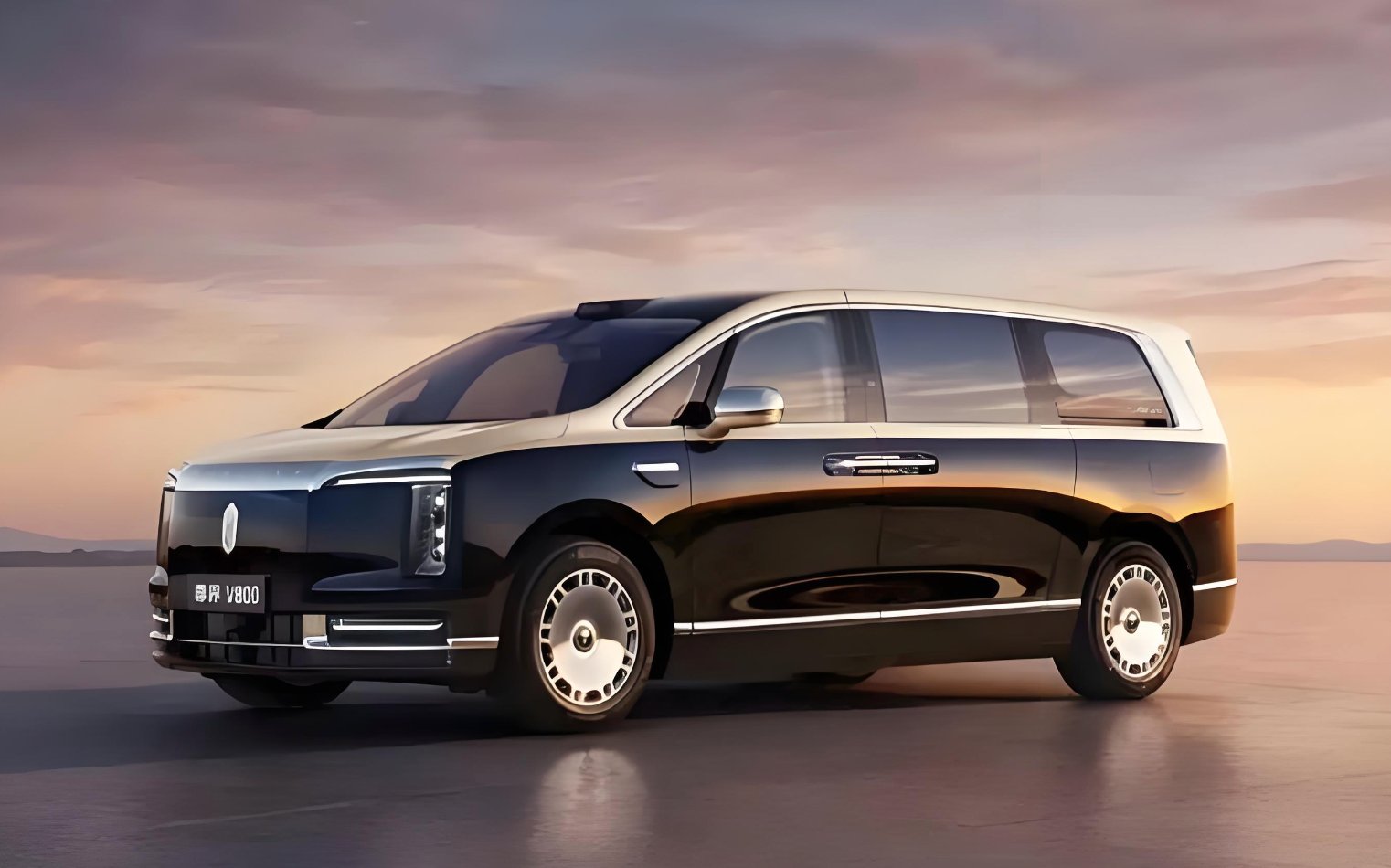
On the first working day after the National Day holiday, the automotive world was jolted awake by a test video.
On October 8, Dongchedi published a braking test video about the Zunjie V800, and the topic "Zunjie V800 brake pedal bracket fracture" quickly surged onto trending searches. On the same day, JAC Motor hit the daily limit down during intraday trading, closing the morning session at 24.72 yuan per share, with turnover exceeding 3.5 billion yuan.
The matter itself is not complicated, but the result is explosive enough.
Three cars, three days, fracture at the same location
According to information disclosed by the tester, from October 1 to 3, Dongchedi conducted emergency braking tests from 100 km/h to 0 on 3 brand-new Zunjie V800s at a closed test track. The first car's brake pedal bracket fractured on the 3rd full-force braking, and the second fractured on the 4th.
To verify whether this was an isolated issue, the tester specifically purchased another brand-new production car for retesting, and the result was that this car's bracket broke on only the 2nd full-force braking.
Three new cars from different batches, the same location, the same fracture mode, and highly similar fracture surface morphology.
After the fracture occurred, the brake pedal directly fell off, the foot went through empty space, the conventional foot brake completely failed, and the driver could only rely on P gear for emergency braking. Test data showed that the braking distance surged from about 38 meters under normal conditions to about 140 meters.
1612 newtons and 4589 newtons
The pedal force sensor readings provided two sets of greatly differing data.
According to information disclosed by the tester, the pedal force reading at the moment of fracture was about 1612 newtons. The national standard's requirement for brake pedals is to withstand 2000 newtons and remain functional for 5 seconds. In other words, the force at the time of bracket fracture was below the threshold specified by the national standard.
But controversy followed. The highest pedal force recorded by the sensor during the entire process once reached 4589 newtons, roughly equivalent to 468 kilograms-force. Some bloggers pointed out after frame-by-frame analysis that the 4589-newton reading appeared after the fracture, not before it. As of press time, Dongchedi has not yet made a public explanation regarding the timing and calibration method of the 4589-newton reading.
What was seen after disassembly
The video included further disassembly analysis.
The distance from the center of the Zunjie V800's brake pedal to the bracket pivot is about 130 millimeters, the longest lever arm among the three models compared by the tester. The longer the lever arm, the greater the impact load borne at the pivot position during braking.
At the pivot area, however, only a single-layer vertical plate was used for support. Comparable models of the same material and from the same supplier generally have 2 to 3 layers of reinforcing vertical plates at this position.
In terms of material, the bracket uses PP+GF40 (polypropylene plus 40% glass fiber). This material is widely used in the automotive industry and is not inherently the problem. But the stress concentration area of the fractured bracket was found to have weld lines - a defect that should be avoided as much as possible in the plastic injection molding process. If the raw material moisture content exceeds the standard during production, mold venting is poor, or equipment parameters deviate, air holes and weld defects are likely to form inside the part, and strength at the defective locations will drop significantly.
Other comparative information showed that for the Zhijie and Wenjie models, which are also part of the HarmonyOS Intelligent Mobility system, their pedal brackets have reinforcing ribs at the pivot and no weld lines were found.
The safety margin of a million-yuan luxury car
The Zunjie V800 is an ultra-luxury MPV jointly built by Huawei and JAC Motor. It launched in August 2026, priced from 766,000 to 1.016 million yuan, positioned directly at the million-yuan high-end market. Within 24 hours of launch, firm orders exceeded 3,500 units, and cumulative orders surpassed 10,000 units in 23 days of presale.
In its promotion, this car emphasized that "eight major systems including braking, steering, and power supply have full-link redundancy design," and it is equipped with Huawei's Tuling Longxing platform, 800V fully active suspension, and the Qiankun ADS 5.0 intelligent driving system.
However, some industry insiders pointed out that the "braking redundancy" in the official wording refers to the brake actuator, and between the driver's foot and the redundant actuator lies precisely this plastic bracket.
Regarding the bracket's designed load-bearing capacity, a blogger responding to netizens mentioned that first-tier luxury brands usually design such brackets with redundancy of 2700N to 4500N, and some brands even require withstanding 3000N at 80°C without fracture, "after all, one must consider the force humans apply to the pedal when adrenaline surges in an emergency."
Official response not yet available
As of press time, neither the Zunjie brand nor JAC Motor has issued a formal investigation conclusion or statement on the matter. The data and disassembly observations provided by the tester all come from third-party videos and have not yet been confirmed by the automaker or an authoritative testing institution.
Online discussion has already split into two camps. Some believe that three new cars from different batches showing the same failure at the same location points to a systemic design or manufacturing problem; others believe that repeated continuous extreme emergency braking is an extreme operating condition and cannot be directly equated with everyday driving scenarios.
Some industry engineers raised in discussion that the national standard assesses static force conditions, while this test involved repeated continuous extreme emergency braking, and the two cannot be directly equated. But the fracture data of 1612 newtons does reflect that there may be a shortcoming in part strength.
It is worth noting that the incident occurred at a time when the Zunjie brand itself was already on a downward sales trajectory. After the Zunjie brand's first model, the S800, reached a delivery peak of 4,223 units in December 2025, sales in 2026 declined almost all the way, leaving only 367 units by July, a drop of more than 90% from the peak. The V800 and V680 began deliveries in August, and the brand delivered about 2,105 units in total in August. The impact of the brake incident undoubtedly adds new variables.
At present, there is no public information on the true cause of the failure, the scope of affected vehicles, or follow-up rectification plans. The incident is still unfolding.


