Looking at global automakers' financial reports and debt ratios, Chinese automakers are more stable!
The competition in China's auto market is unprecedented, so how are the financial conditions of various automakers? Compared with international automakers, which Chinese automakers are doing better?
First. Regarding asset-liability ratios, Chinese automakers are generally lower than mainstream international automakers.
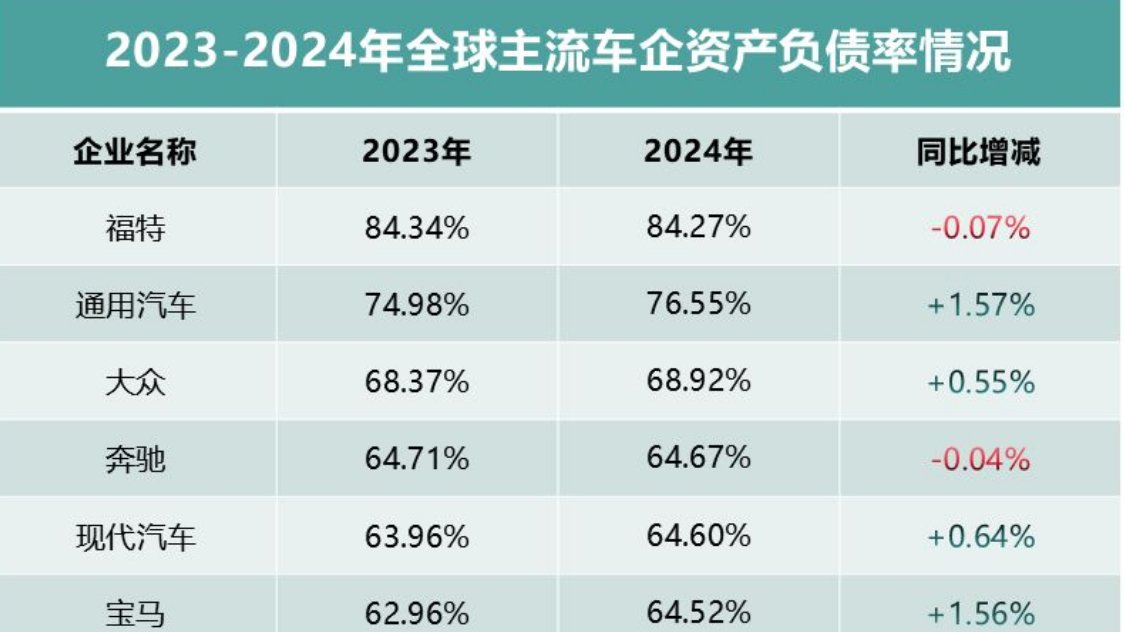
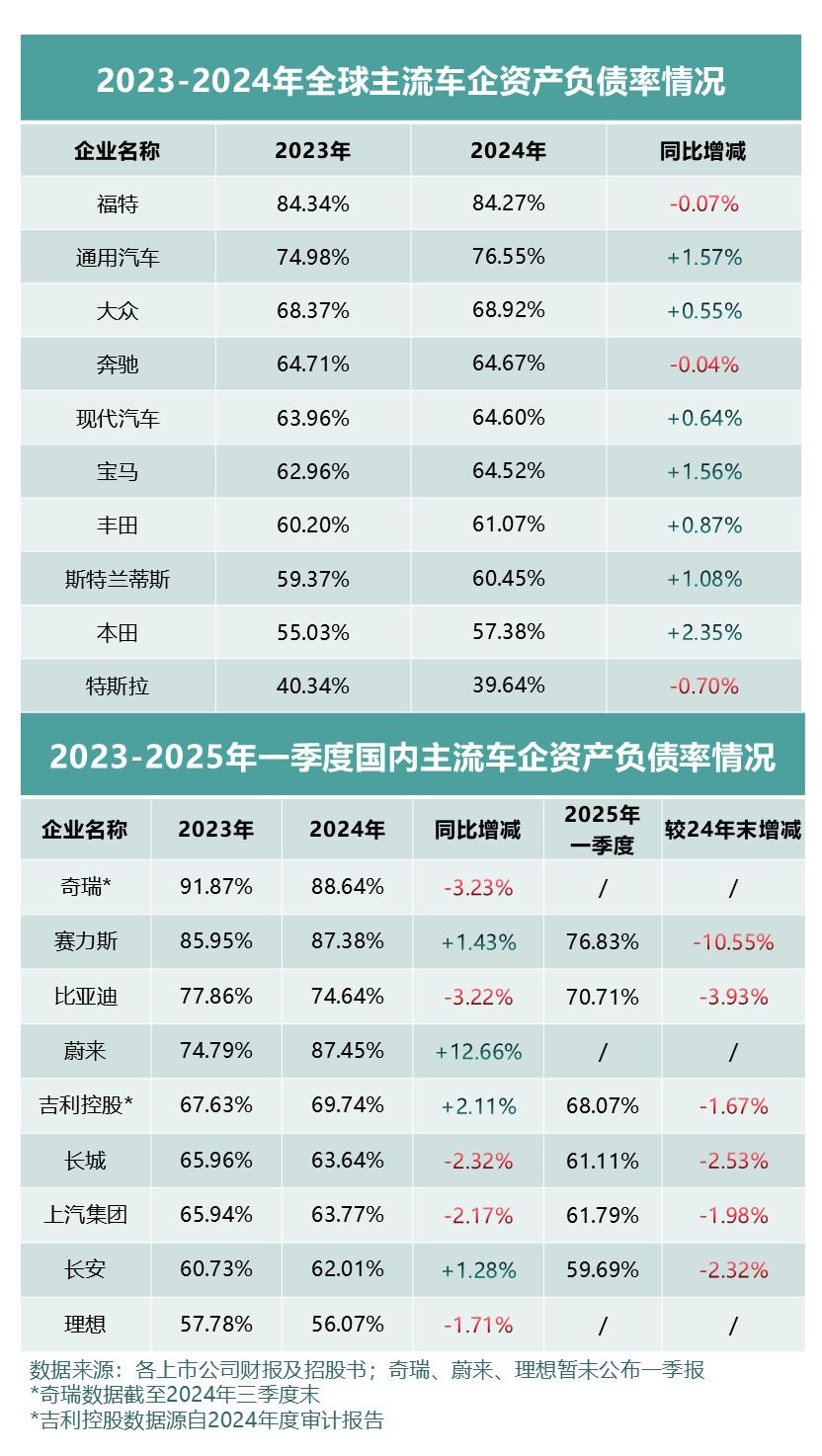
As a special industry with a long industrial chain and long product development cycles, a high debt ratio is a common feature of global automakers, and total liabilities are proportional to enterprise scale and revenue. From the table below, it can be seen that in 2024, Ford's debt ratio was 84.27%, and General Motors was 76.55%; among domestic automakers, in 2024, Chery's debt ratio was 88.64% (as of the end of the third quarter), NIO's debt ratio was 87.45%, and Seres was 87.38%. These few are at relatively high levels.
Overall, for Volkswagen, Mercedes-Benz, Hyundai, BMW, as well as domestic BYD, Geely, SAIC, Great Wall, Changan, and others, asset-liability ratios are also above 60%.
But from the trend perspective, the downward trend in domestic automakers' debt ratios is very obvious. Among domestic automakers that have disclosed their 2025 first-quarter reports, BYD has already dropped to 70.7%, with its debt ratio falling by nearly seven percentage points in the past half year. Within this year, its debt ratio is very likely to fall into the "6" range.
Second. The debt structure is different, and operating pressure differs greatly.
Overall, compared with mainstream international automakers, Chinese automakers are more conservative in financial management.
As of the end of 2024, Volkswagen Group's revenue was 2.5 trillion yuan, with total liabilities reaching 3.4 trillion yuan; Toyota's revenue was 2.2 trillion yuan, with total liabilities reaching 2.7 trillion yuan; Ford's revenue was 1.3 trillion yuan, with total liabilities reaching 1.7 trillion yuan. Basically, the total liabilities of international automakers are generally 20-30% higher than their total revenue.
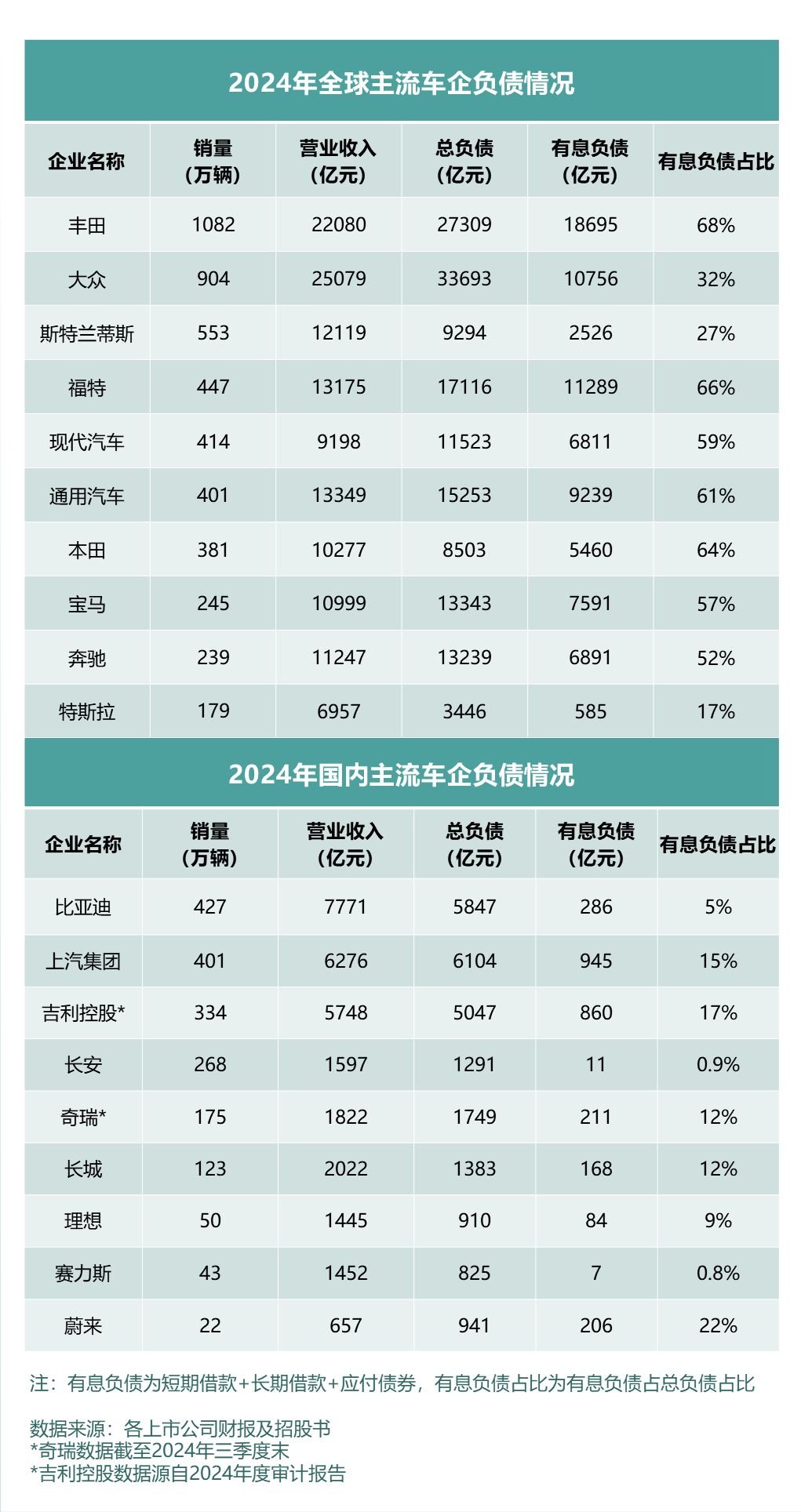
Among Chinese automakers: BYD's revenue was 777.1 billion yuan, with total liabilities of 584.7 billion yuan; Geely Holding's revenue was 574.8 billion yuan, with total liabilities of 504.7 billion yuan; Chery's revenue was 182.2 billion yuan, with total liabilities of 174.9 billion yuan; SAIC Group's revenue was 627.6 billion yuan, with total liabilities of 610.4 billion yuan. The total liabilities of each automaker are generally lower than total revenue.
In particular, from the perspective of the proportion of interest-bearing liabilities: Toyota's interest-bearing liabilities are about 1.87 trillion yuan, accounting for 68% of total liabilities; Volkswagen Group's interest-bearing liabilities are about 1 trillion yuan, accounting for 32% of total liabilities; Ford's interest-bearing liabilities are about 1.1 trillion yuan, accounting for 66% of total liabilities. The higher the proportion of interest-bearing liabilities, the greater the financial pressure.
In contrast, domestic mainstream automakers generally have relatively low interest-bearing liabilities: Geely Holding's interest-bearing liabilities are 86 billion yuan, accounting for 17% of total liabilities; Chery's interest-bearing liabilities are 21.1 billion yuan, accounting for 12% of total liabilities (as of the end of the third quarter); Great Wall Motor's interest-bearing liabilities are 16.8 billion yuan, accounting for 12% of total liabilities; BYD's interest-bearing liabilities are about 28.6 billion yuan, accounting for only 5% of total liabilities, placing it among the lowest levels among mainstream domestic and international automakers.
Third. Shorter payment cycles, friendlier to suppliers.
As the saying goes, the duck knows first when the river warms in spring. As closely coordinated upstream and downstream partners, the payment cycle to suppliers is also one of the important indicators reflecting an enterprise's financial condition.
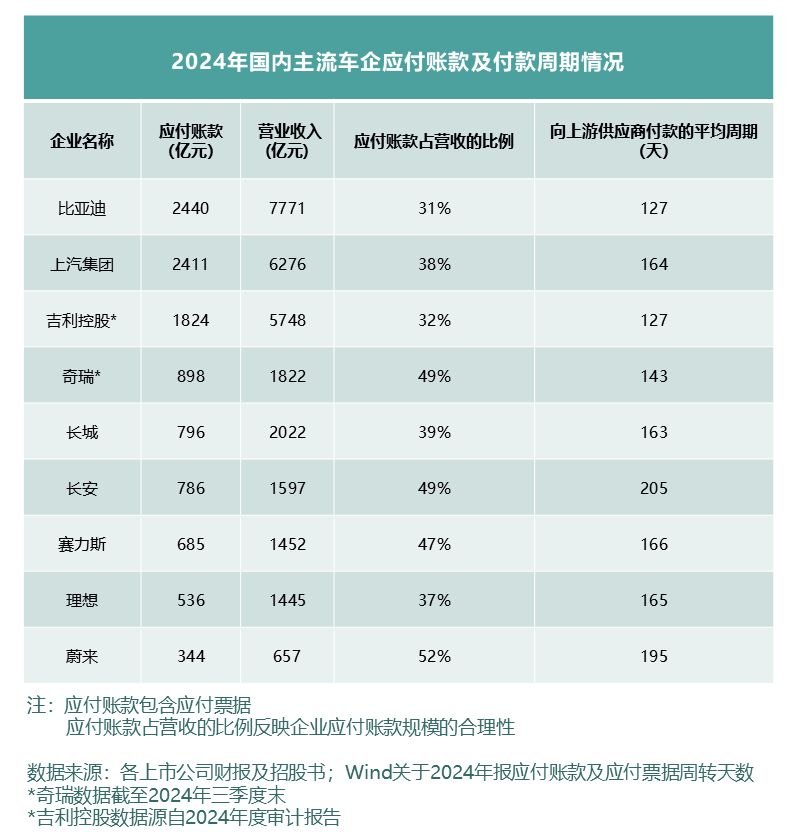
According to Wind data, as of the end of 2024, BYD's average payment cycle to upstream suppliers was 127 days, tied with Geely Holding for the shortest; Chery was 143 days (as of the end of the third quarter), Great Wall Motor was 163 days, NIO was 195 days, and Changan exceeded 200 days.
Therefore, overall, although competition in China's auto market is fierce, the development state of the entire auto market is still healthy and upward. Through technological innovation and industrial chain integration, we not only provide high-quality products that ordinary people can afford, but enterprises can also maintain a healthy and reasonable financial condition. Only in this way can we persist; only in this way can we go steadily and far!


