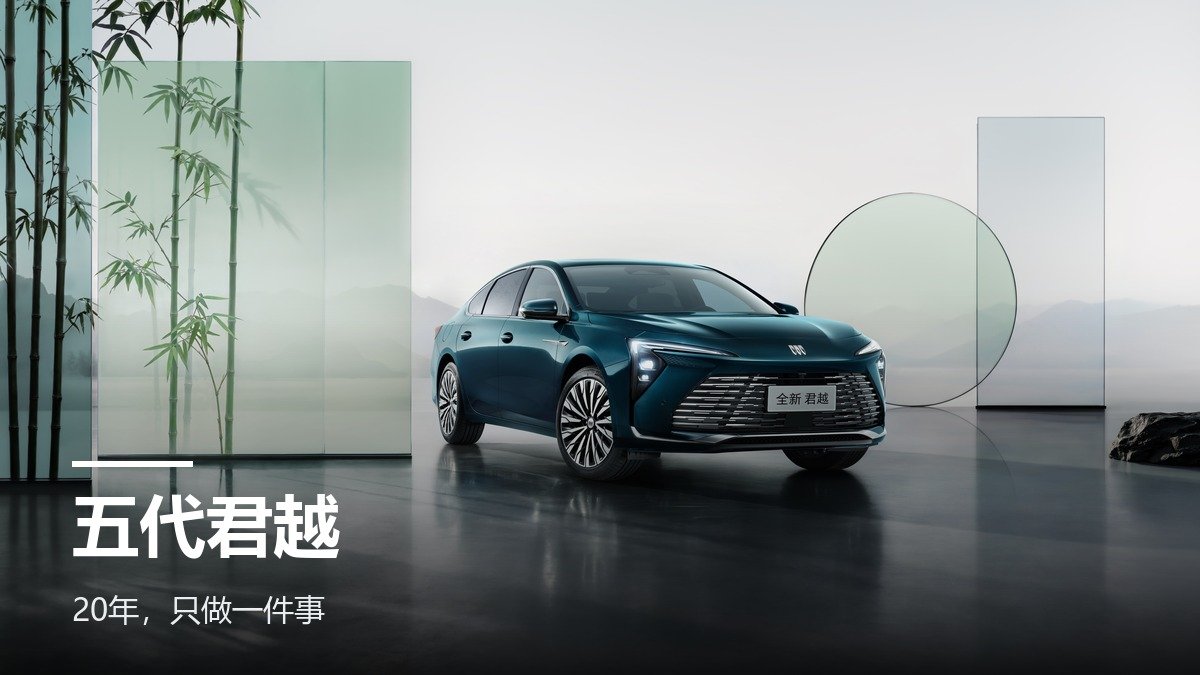
On October 10, the all-new fifth-generation LaCrosse was officially launched, with a limited-time权益 price of 149,900 to 169,900 yuan.
To be honest, I've always liked the LaCrosse, and the reason is simple: the body is long enough, the look is imposing enough, and the power and handling are more than sufficient. And among B-segment cars, it is one of the few that has taken the idea of "big" this thoroughly.
For this model line, the LaCrosse has done only one thing for twenty years: move value upward.
When the LaCrosse entered China in 2006, it already treated a 5-meter body length as its ticket in.
What was the domestic B-segment like back then? The Passat and Magotan were generally around 4.8 meters long. The LaCrosse pushed the size straight to 5 meters, which counted as opening the way in China's mid-to-high-end sedan market.
By the third generation in 2016, the 5018mm length and 2905mm wheelbase had been set. The Passat and Magotan of the same period both had a 2871mm wheelbase, more than 30 millimeters shorter.
In real-world experience, that gap means rear passengers get an extra fist's width between their knees and the front seats. When picking up clients or taking parents out, you can feel that extra fist's width.
So in those years the LaCrosse sold well, and the saying "spend B-segment money for C-segment presence" was something it earned for itself.
Back to the fifth generation, the wheelbase is still its trump card.
The all-new LaCrosse is 5003mm long, with a 2905mm wheelbase and a track width of more than 1.6 meters.
To be honest: this time the body dimensions have barely changed. The real advantage is still the wheelbase—2905mm, still 34mm longer than the current Passat and Magotan (2871mm).
By the way, here's a benchmark: the long-wheelbase BMW 5 Series is 5175mm long with a 3105mm wheelbase, so the LaCrosse is 17 centimeters shorter and has a 20-centimeter shorter wheelbase. So saying "the LaCrosse is a C-segment car" is not rigorous; a more accurate way to put it is: its size specification reaches the doorstep of the executive class, while its price stays in the B-segment.
What exactly has changed in this generation
First, a detail that is easy to overlook: R19 star-radiance wheels with Bridgestone Turanza self-sealing tires, which can automatically seal punctures from foreign objects up to 5mm in diameter. In most cases after picking up a nail, you don't have to squat by the roadside changing a tire—anyone who has taken a long drive understands this.
The cabin is where the most effort went this time. The first thing you see when you sit inside is a wraparound yacht-style design, with curved chrome trim running from the door panels all the way across the instrument panel and center console, plus extensive soft wrapping with metal accents and cloud-pattern wood trim.
The seat adjustment buttons have been moved to the door panels, within reach without having to look down and fumble along the side of the seat. The seats have also been fully redone: new cloud-feel pressure-relief seats, diamond-pattern quilting, front headrest foam thickened from 10mm to 15mm, and seat cushion foam thickened by 25mm compared with the previous generation.
In plain terms: after three or four hours on a long drive, fatigue in your lower back and legs will be noticeably lighter.
On features, what I approve of most is the phrase "standard across the range." Front-row heating, ventilation, massage, and even the front passenger boss button are available from the entry version. On the Magotan and Passat at the same price, these items require moving up trim levels. The Ultra version goes even further, with four full-function seats, and heating, ventilation, and massage in the rear as well, plus 35° sleep headrests.
Quietness is Buick's signature strength. 5.4mm double-layer acoustic glass, 3 door seals, ANC active noise cancellation, plus 11 Bose surround speakers. Close the door and drive on the highway, and rear-seat passengers can chat without raising their voices.
On intelligence, this is the most noteworthy part of this facelift.
The all-new LaCrosse is Buick's first gasoline sedan equipped with the Xiaoyao electronic architecture. The key is that it can receive continuous OTA upgrades like an EV, so it can stay fresh even after you buy it. It is also the first joint-venture gasoline car to debut the Doubao AI large model.
What is it like in actual use? You don't need to memorize fixed commands. If you say "I'm a bit cold," it knows to adjust the air conditioning; if you say in one sentence, "open the sunroof, turn the seat ventilation up, navigate to the office," it can understand it all at once and execute everything. It supports dialect recognition and can remember context.
On driver assistance, APA automatic parking is standard across the range and can cover 7 types of parking spaces. For a 5-meter-long car, it can park itself into narrow spaces and dead ends, which is very practical for beginners. The Ultra version also adds remote parking via phone; when the space is too narrow to open the door, you get out and use your phone to guide it in.
Full-speed-range ACC, lane centering, 360° surround view, and DMS fatigue monitoring are all standard as well.
Powertrain and chassis are the hardest part of the word "class-above."
The all-new LaCrosse comes standard across the range with the eighth-generation Ecotec 2.0T engine paired with a 9AT, with a maximum power of 174kW, peak torque of 350N·m, and 0-100 km/h acceleration in 7.2 seconds.
The key point is that there is no division between high and low power output; the entry version is already the full specification. The Passat and Magotan divide power by trim, with 1.4T/1.5T on lower trims and 2.0T only available on mid-to-high trims. The LaCrosse saves you from having to make that choice.
The chassis uses a full-frame soft-connected subframe, front lower control arms with hydraulic bushings, a rear four-link independent suspension, and aluminum steering knuckles, tuned with more than 200 sets of schemes for Chinese road conditions.
Finally, the price.
From 149,900 yuan. What this price corresponds to is a 5-meter body length, a 2905mm wheelbase, standard 2.0T+9AT across the range, and a set of AI large-model features appearing for the first time in a joint-venture gasoline car.
Across five generations and twenty years, what Buick has always been doing is delivering an imposing exterior presence and solid interior quality at a price ordinary people can reach.
The fifth-generation LaCrosse still follows the same logic. For 149,900 yuan, what you buy is not just four wheels and a badge.


