Li Auto held a Power Day today, officially unveiling its long-guarded "Lianshan" electric technology system. Simply put, it's three things: battery, electric drive, and supercharging—all self-developed, all fully integrated.
Let's start with the battery. The Lianshan battery is built around 5C supercharging—500 kilometers of range from a ten-minute charge, a figure that should be familiar by now. But this time Li Auto focused on how to make fast charging more than just a lab number—they optimized at the cell material level, and the all-new L8 with the self-developed 5C ternary lithium battery now achieves 430 kilometers of pure electric range, while the i6 stretches that to 780 kilometers. The lithium iron phosphate side hasn't been left behind either—self-developed algorithms have improved both low-temperature range and state-of-charge estimation accuracy, adding thirty kilometers of equivalent range in winter, and after next year's OTA, another ten kilometers can be squeezed out even at minus twenty degrees Celsius. On safety, they've built six lines of defense, covering everything from impact protection to thermal runaway prevention—a single cell failure at fifty degrees Celsius won't catch fire within twenty-four hours, and the battery has earned IPX8 and IPX9K top protection ratings. On the production side, every cell's data is traceable for twenty years, and vehicle-side plus cloud-side systems can provide risk warnings seventy-two hours in advance.
On the electric drive front, Li Auto began developing its own platform back in 2021, and now both the five-in-one and silicon carbide three-in-one units are in mass production and on vehicles. The new-generation electric drive adds roughly thirty kilometers of range and frees up twenty-four millimeters of interior height. On reliability, four million self-developed power chips have been deployed with zero failures, every electric drive unit passes ninety-three inspection steps off the line, and records are kept for fifteen years. Li Auto's i8 powertrain even made the cover of Germany's MTZ journal—a first for a Chinese automaker.
The supercharging network is the part that's been deployed fastest. It has already built 4,200 supercharging stations with over 23,000 stalls, covering twenty-five national expressway trunk lines and 138 scenic charging routes. Over ninety-five percent of highway stations are inside service areas, equipment availability exceeds 99.9 percent, and charging can start in as little as thirteen seconds after plugging in. Li Auto plans to have one station every hundred kilometers on national expressway trunk lines by year-end, and to expand 5C supercharging stalls to 8,300 before next year's Spring Festival. In the fourth quarter, it will also roll out 5C priority parking spaces, with features like a map-based travel agent coming through subsequent OTAs.
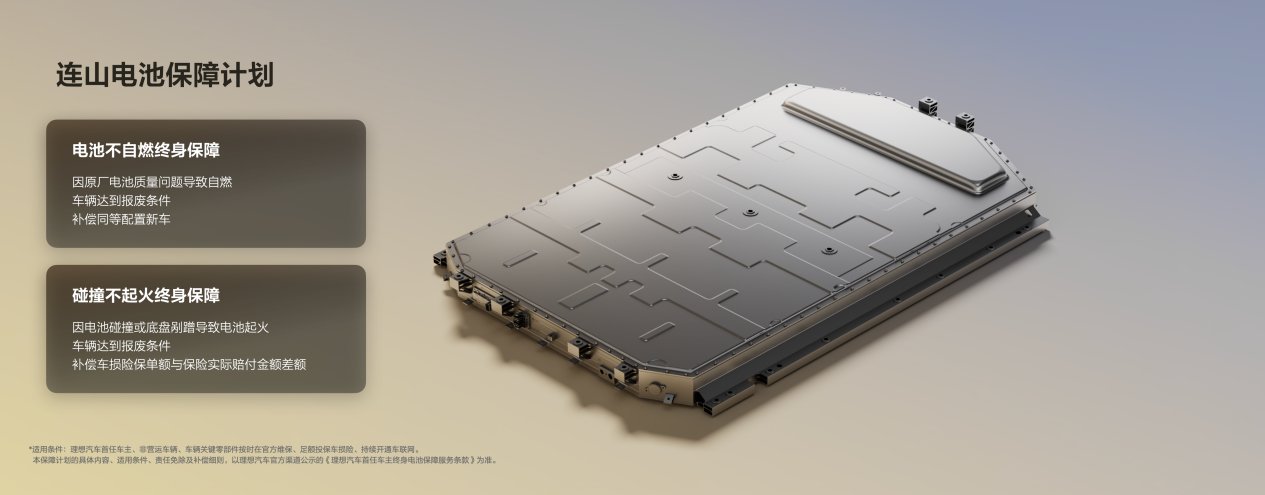
Finally, there's a rather bold move—the "Lianshan Battery Assurance Plan." If a self-developed battery catches fire due to its own quality issues and the vehicle is declared a total loss, Li Auto will compensate with a new car of equivalent configuration; if a collision or scrape causes a fire, the company will cover the gap in insurance payouts. This essentially upgrades battery safety from a technical promise to a corporate backstop, giving users considerable peace of mind for long-term ownership.
Overall, this isn't a single-point breakthrough from Li Auto—it's about connecting battery, electric drive, charging, and cloud monitoring into one line. Ma Donghui's statement that "you can't rely on individual components alone; you have to connect the entire chain" essentially captures the core logic of this launch event.


