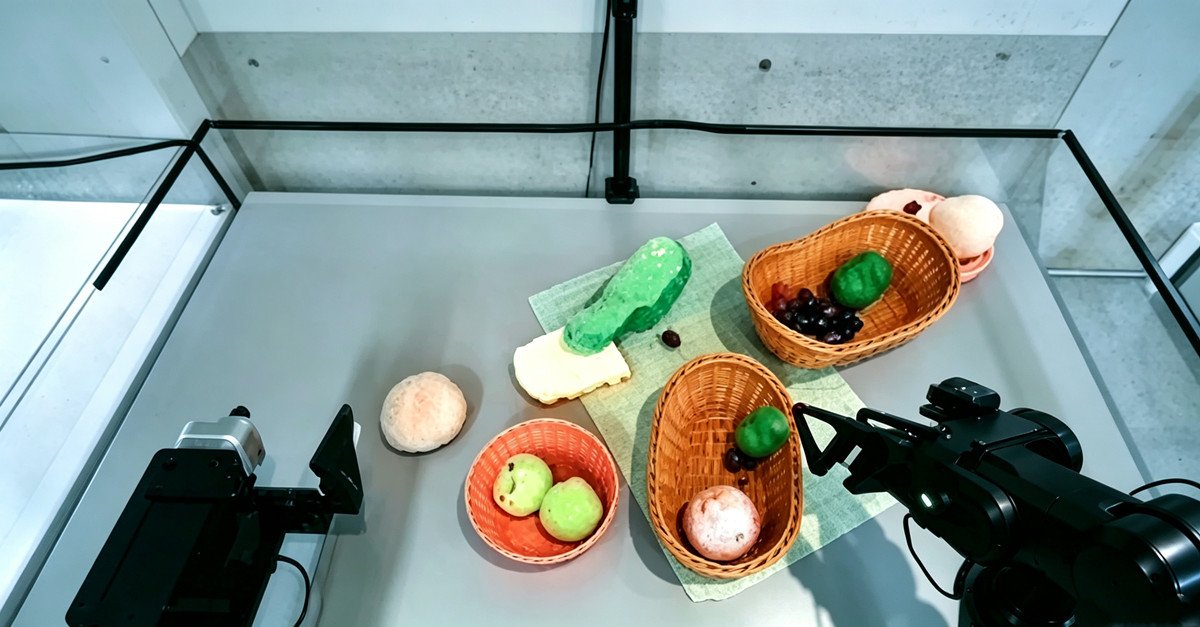
Developers can now use an open API to make robots perform real-world tasks—stacking towels, closing drawers, hanging headphones—by issuing commands in natural language, just like asking ChatGPT a question.
On October 20, Dream Labs, founded by a team of former core members of NVIDIA GR00T, launched Dream API, the world's first publicly open robot foundation model API. Mifeng Technology provides end-to-end services for its underlying World Action Model Dream-1, covering egocentric-free data, real-robot data, real-robot testing, and evaluation, supporting model R&D and zero-shot generalization feasibility validation.
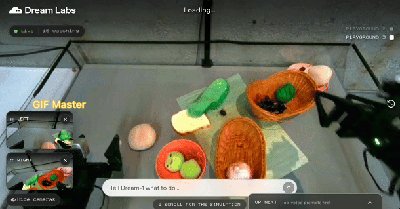
As robot hardware costs continue to decline, the industry urgently needs a "general-purpose brain" that can be reused across tasks and embodiments, reducing the cost of retraining and adapting every time a robot or task changes. Dream API opens robot model capabilities to the public in API form, so developers without a machine learning background can connect their own robots and drive them to execute tasks through natural language instructions. Dream-1 is priced at $3 per hour. More than 20 hardware manufacturers have already joined the partnership.
Dream API is powered by the World Action Model (WAM) Dream-1, which jointly learns video prediction and action generation and can control robots in real time and in a closed loop. According to the team, in simulation evaluations across 27 unseen robots, 24 achieved more than half the performance of the training embodiment YAM; on real robots, Dream-1 can complete tasks such as folding towels, closing drawers, and hanging headphones without additional training on target-robot-specific data. At present, its zero-shot cross-embodiment capability is mainly aimed at dual-arm parallel-jaw gripper robots.
Enabling robots to "get started zero-shot" on new embodiments depends on the accumulation of training data and validation through real execution.
In this collaboration, Mifeng Technology provides egocentric-free data for pretraining the Dream-1 World Action Model, using rich human manipulation and object interaction information to help the model learn the operation processes of different tasks; it also provides real-robot data to supplement the motion, manipulation, and contact experience from actual robot execution. The two types of data complement each other, supporting the model's capability learning and iterative optimization.
From data supply to real-robot validation, Mifeng further provides testing and evaluation services to help the team verify the feasibility of Dream-1's zero-shot generalization on new embodiments. By observing the robot's understanding of instructions, task execution process, and completion, it evaluates whether the model's existing capabilities can transfer to new robots, identifies issues during execution, and provides a basis for subsequent data supplementation, model optimization, and embodiment adaptation.
As a one-stop physical AI data service platform, Mifeng has built a data service system covering egocentric-free data, real-robot teleoperation, and simulation. By supporting Dream-1 this time, it connects data supply with execution validation, further expanding Mifeng's practice in serving foundation model R&D.
In the future, Mifeng will continue to expand high-quality data supply, improve data governance, standardized delivery, and real-robot evaluation capabilities, provide end-to-end services for model R&D teams, robot manufacturers, and research institutions, and drive robot models toward more real-world scenarios.


