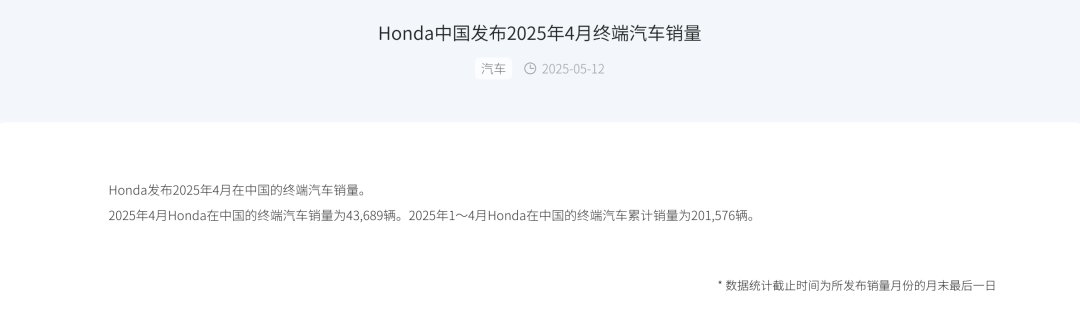
Recently, sales data released by Honda China shows that terminal automobile sales in April 2025 were 43,689 units, a decrease of 40.8% compared with the same period last year. Cumulative sales from January to April this year were 201,576 units, a year-on-year decrease of 28.2%. This scorecard reflects that this multinational automaker, which has cultivated the Chinese market for thirty years, is facing unprecedented transformation pressure.
Warning signals from the sales curve
Looking back after reaching a sales peak of 1.627 million units in 2020, Honda's sales in China have declined for five consecutive years: a year-on-year decline of 4% in 2021, an expanded decline of 21% in 2022, a narrowing to 10% in 2023, and a decline that climbed again to 31% in 2024. This continuously downward curve forms a sharp contrast with the current structural changes in China's automobile market.
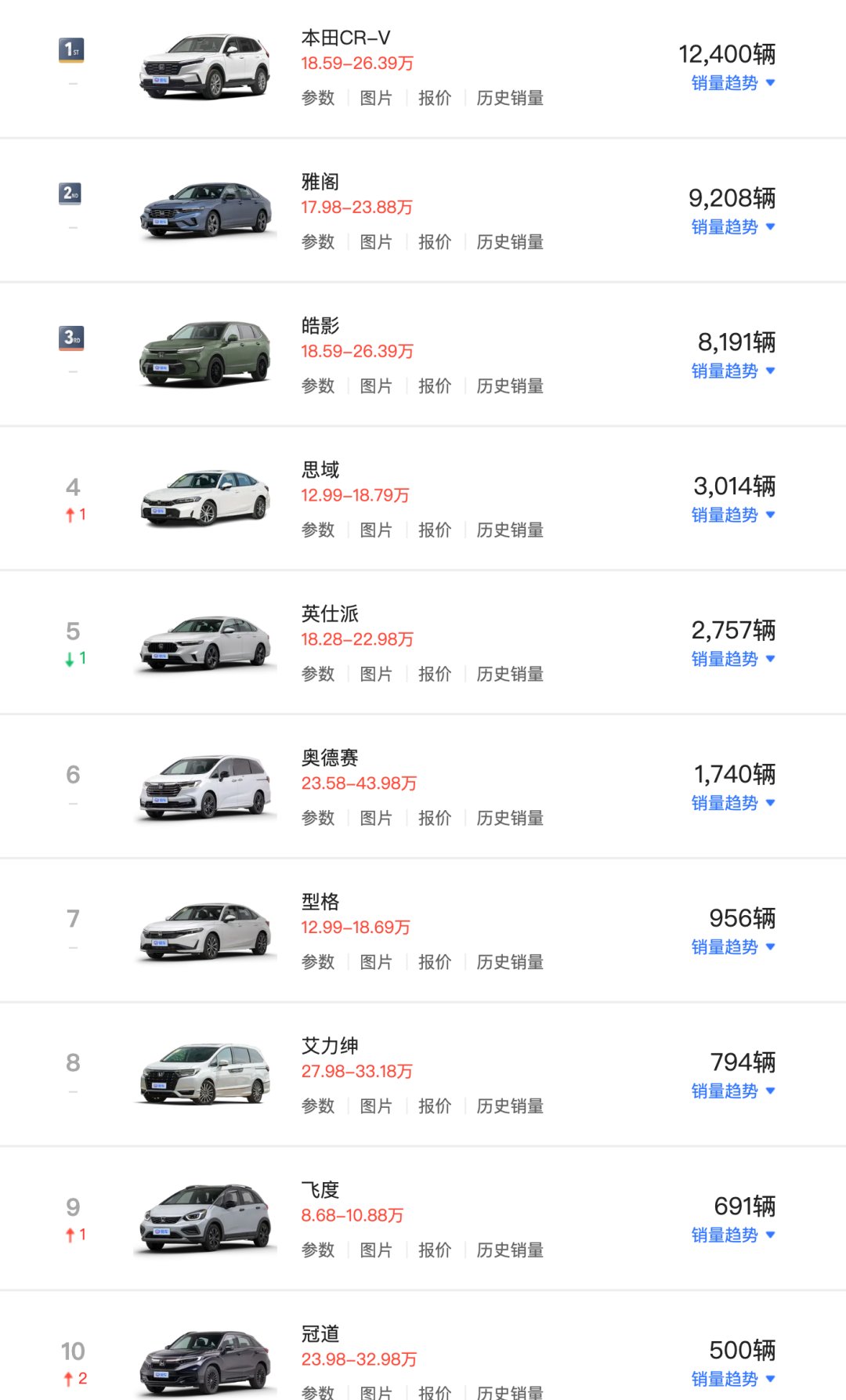
Specific model performance further highlights the depth of the crisis: the CR-V, as the only model with monthly sales exceeding 10,000 units, posted 12,400 units, a clear gap from its historical high; classic models such as the Accord and Breeze hover below the 10,000-unit threshold; the newly launched GAC Honda P7 delivered 432 units in its first month, while the Dongfeng Honda S7 recorded sales of only 62 units, reflecting the phased dilemma of the new energy transformation.
A multidimensional perspective on structural challenges
In China's market, where new energy penetration has exceeded 50%, Honda faces not only the test of product iteration, but also a deeper challenge from the reconstruction of system capabilities. At present, Honda's two joint ventures in China have launched a total of 10 new energy models, but their price range spans 150,000 to 310,000 yuan, and there is overlap in product positioning. The recent pricing adjustment by Dongfeng Honda for the S7 reflects that the company's response to market competition still appears passive. On the channel network side, the contradiction between the traditional 4S store model and the direct-connection needs of new energy users is gradually emerging.
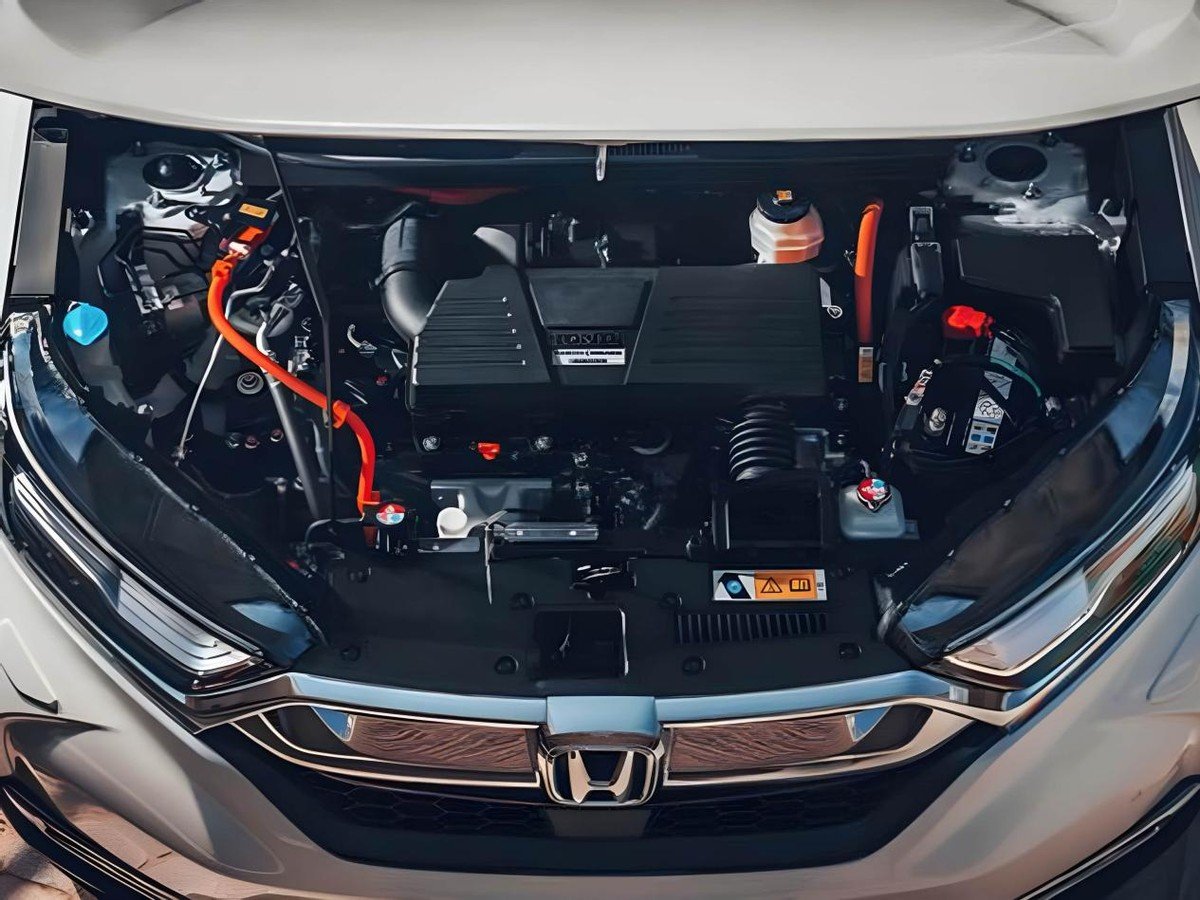
It is worth noting that Honda still has an advantage in its technological accumulation in the hybrid field. Cumulative installations of the i-MMD system have exceeded 500,000 units, and it still maintains relatively high recognition in non-restricted purchase cities. How to transform this technological advantage into a competitive barrier in the electrification era may determine the final effectiveness of the transformation.
Dialectical thinking on the market landscape
China's automobile industry is currently at a key juncture of a century-scale transformation. For multinational automakers, they must not only respond to the technological challenges of the new energy transformation, but also solve the organizational difficulties of localized innovation. Honda's case is typical: it has both the advantages of global technological reserves and a quality control system, and also faces the inherent limitations of a longer decision-making chain and slower market response speed.
Industry insiders point out that 2025-2027 will be a key window period for the transformation of foreign brands. With the implementation of the EU carbon tariff policy and the tightening of the domestic dual-credit system, the cost of strategic wavering between fuel vehicles and new energy vehicles will increase significantly. Whether a differentiated advantage can be established in the field of intelligent electrification will become a core factor in competition in the stock market.
Standing at the crossroads of industrial transformation, Honda China's road to transformation is full of challenges as well as opportunities. For observers concerned about the automobile industry, this company's strategic choices and technological breakthroughs will provide an important model for judging the transformation of multinational automakers. The market will ultimately test whether profound technological accumulation and decisive transformation resolve can truly be converted into market competitiveness in the new era.


