On October 19, 2026, the Wey Highland 8 HEV officially opened for pre-orders, with a reservation price of 275,800 yuan, while also offering first-owner, non-commercial-use lifetime free basic maintenance benefits. Placed in the current window of密集 new-car launches, this price itself is not exactly explosive.
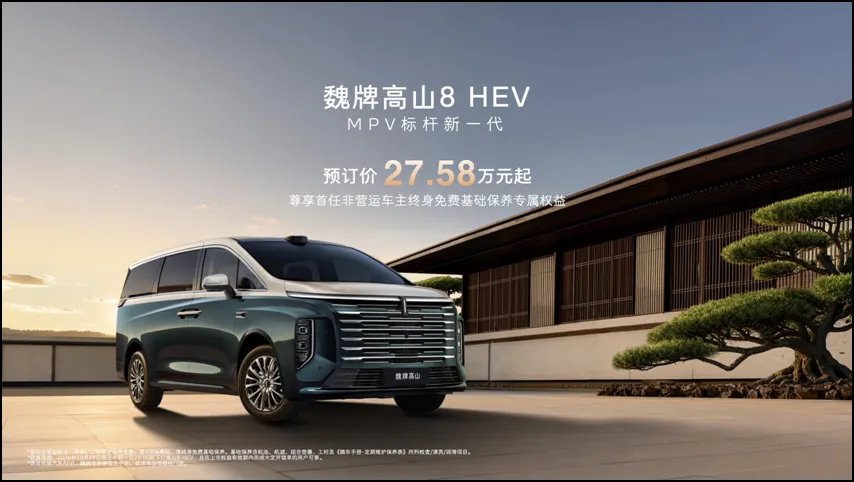
What is truly worth examining is where this vehicle positions itself: it targets a group of users who have long been "defaulted by the market as able to compromise"—blue-plate MPV buyers who have no home charging conditions, are used to fueling up and driving off, yet do not want to keep tolerating "good enough is fine" in intelligence, power, and comfort.
For many years in the past, the competitive logic of the blue-plate hybrid MPV market was extremely one-dimensional. Sienna and Granvia used the trio of fuel efficiency, durability, and value retention to firmly anchor user expectations on "economy." Intelligence? That was the narrative of green-plate new forces. Four-wheel drive and performance? What zero-to-hundred acceleration does an MPV need to talk about? Fridge, TV, big sofa? Too flashy, not practical.
This logic was self-consistent in the era of fuel vehicles, but in the market context of 2026, it is turning into a kind of structural product inertia: it is not that users do not want it, but that mainstream supply has long failed to offer a "no compromises" option. The entry of the Highland 8 HEV is essentially using a set of PHEV-level intelligence and performance configurations to answer a question HEV users are too embarrassed to ask—if I refuel, do I not deserve to use good things?
I. The "good enough" trap of blue-plate MPVs has been punctured by a single lidar
The most obvious label of the Highland 8 HEV is "the only blue-plate MPV in its class with standard lidar." One 192-line lidar, 27 perception hardware units, an Orin-Y domain controller, 200TOPS of computing power, matched with Coffee Pilot 3, supporting highway and urban NOA, one-key activation from a curbside start in P gear, and a full no-interruption process from exiting the parking space to automatic parking at the destination. This hardware specification is not rare among 300,000-yuan-class green-plate MPVs, but within the blue-plate HEV MPV category, it is indeed the first time.
Here it is necessary to clarify a fact that is easily blurred by marketing rhetoric: blue-plate MPV users' demand for intelligent driving is not lower than that of green-plate users. On the contrary, the high-frequency use scenarios of MPVs—narrow-road passing in old residential compounds, finding parking spaces in dim underground garages, repeatedly maneuvering in dead-end spaces, and long-distance full-load highway cruising—have a higher dependence on driver assistance. The long-term absence of Sienna and Granvia in this dimension is not because users do not need it, but because the product iteration rhythm of Japanese hybrid MPVs simply did not put intelligence on the priority list. By stuffing lidar and high-level NOA into the blue-plate category, the Highland 8 HEV is less a case of "leapfrogging" than of forcibly pulling a deliberately ignored shortcoming above the passing line.
Of course, stacking hardware does not mean the experience will necessarily be good.
The actual usability of urban NOA, the takeover frequency in complex road conditions, and the success rate in parking scenarios all require real-vehicle verification; they are not questions a specification sheet can answer. But at least one thing is certain: while competitors are still using cruise control to cope with highway scenarios, the Highland 8 HEV has provided a foundation with continuous OTA evolution capability at the hardware level. This generational gap cannot be filled by "fuel efficiency."
II. 2.0T + four-wheel drive + 5.9 seconds—is talking about performance for MPVs a false proposition?
The Highland 8 HEV is equipped with a 2.0T hybrid-dedicated engine + four-speed Hi4 performance-version intelligent four-wheel drive, with a system maximum power of 322kW, maximum torque of 782N·m, zero-to-hundred acceleration in 5.9 seconds, and WLTC combined fuel consumption of 6.92L/100km. For an MPV with a body length exceeding 5.2 meters and a wheelbase of 3145mm, this set of figures would probably have been regarded as "over-engineering" two years ago. But in real vehicle-use scenarios, performance redundancy has never been about showing off; it is part of safety redundancy.
With seven people plus luggage at full load, a half-second delay in power response when overtaking a large truck on the highway is a risk window; slipping when starting on rainy or snowy slick roads, and understeering through corners on mountain roads, are stability gaps. The "good enough" power calibration of traditional blue-plate hybrid MPVs is indeed sufficient for unloaded commuting, but in high-frequency extreme scenarios such as full-family load, long-distance uphill climbing, and winter freezing rain, the margin is stretched thin. The Highland 8 HEV uses 2.0T + dual motors + four-wheel drive to raise the power ceiling, combined with a 5.7-meter minimum turning radius and an all-aluminum suspension, essentially solving a problem MPV users are too embarrassed to complain about: a big vehicle does not have to be driven only slowly, and full load does not mean you can only endure pressing the pedal.
Fuel consumption of 6.92L/100km is indeed not stunning within the HEV category, but considering the 322kW system power and four-wheel-drive architecture, this figure is a reasonable engineering compromise. Wanting the horse to run yet not eat grass is physically impossible; the choice of the Highland 8 HEV is to downgrade "fuel efficiency" from the sole selling point to a baseline item, and to pull performance and handling into the weighting table of purchase decisions. Whether this trade-off holds ultimately depends on whether users are willing to pay for "not feeling guilty when overtaking at full load." Judging from the foundation of the Highland family's PHEV version with cumulative 120,000+ users and family users accounting for nearly 80%, acceptance in this direction should not be low.
III. The value ledger of 275,800 yuan: what is compared is not just price, but the "cost of compromise"
Compared with the Sienna Comfort Edition's guided price of 298,800 yuan, the Highland 8 HEV's reservation price is 23,000 yuan lower, with nearly 100 more configuration items.
This comparison itself seems to have a marketing element—the statistical scope for counting configuration items can be very broad—but the generational gaps in several key items are real: lidar + urban NOA versus cruise control, 2.0T + four-wheel drive versus 2.5L front-wheel drive, 8295P cockpit chip versus traditional Japanese infotainment, second-row zero-gravity seats + third-row ventilation and heating + 12.5L fridge + 17.3-inch rear screen versus a "bare shell" interior. The estimate of a perceived value gap exceeding 80,000 yuan may be inflated, but the "configuration gap you can feel as soon as you sit inside" does indeed exist.
What is more worth calculating is the ownership cost ledger. The Highland 8 HEV offers lifetime warranty for the three electric systems, 6 years/150,000 km vehicle warranty, and lifetime free basic maintenance, compared with the Sienna's 3 years/100,000 km vehicle warranty. For a family MPV planned to be used for more than five years, the difference in warranty period, converted into real money, is not a small amount. In addition, the 2.0T displacement can enjoy the national trade-in subsidy (15,000 yuan for scrapping an old vehicle / 13,000 yuan for transferring an old vehicle), while the Sienna's 2.5L displacement cannot enjoy this policy, so the actual price difference at the purchase stage will further widen.
Of course, the Sienna's value retention rate and channel reputation are assets accumulated over many years, and the Highland 8 HEV, as a new entrant, cannot match it in brand premium and second-hand residual value in the short term.
But "worth buying" and "cost-effective to use" are two separate ledgers, and the Highland 8 HEV has calculated the second ledger very clearly: lifetime free basic maintenance + lifetime warranty for the three electric systems + a lower guided price, targeting family users who plan to drive the vehicle until it is scrapped and are sensitive to long-term ownership costs. These people may not necessarily not care about the brand, but they care more about whether every penny spent brings back an equivalent experience.
IV. The true meaning of the "Gao-Feng contest": not replacing Toyota, but rewriting the exam questions
An awkward situation is that if we repeatedly mention the "Gao-Feng contest" and "Feng turning to Gao," it seems easy to simplify the competitive landscape into "who kills whom." Therefore, Douzi believes a more accurate judgment is: the emergence of the Highland 8 HEV has changed the scoring rules of the blue-plate hybrid MPV market.
In the past, when users chose the Sienna, the core logic was "fuel efficiency + reliability + value retention," and intelligence and performance were actively abandoned items because "there was no choice." Now the Highland 8 HEV has put lidar, four-wheel drive, the 8295P chip, and zero-gravity seats on the table, and users' decision chain is forced to lengthen: are you willing, in order to save fuel and retain value, to continue accepting an MPV whose infotainment responds half a beat slower, whose highway cruising relies entirely on your foot, and whose full-load overtaking relies on prediction? Once this question is asked, the "comfort zone" of the Japanese duo is no longer comfortable.
But the other side must also be seen: the configuration advantages of the Highland 8 HEV need real-vehicle experience to be delivered. The actual performance of urban NOA, the energy consumption control of the four-wheel-drive system, the response speed of the cockpit VLA, and the real comfort of the third-row seats in long-distance scenarios—these cannot be fully conveyed by a specification sheet. The Wey Highland family has already accumulated 120,000+ users in the PHEV market and the foundation of being the new-energy MPV sales champion, but the user profile and usage habits of the HEV category differ from those of PHEV users—they are more conservative, value reliability more, and have lower tolerance for new things.
What the Wey Highland 8 HEV needs to prove is not just "higher configuration," but that "these configurations will still work well and still not break down five years from now."
Written at the end
The 275,800-yuan Highland 8 HEV is essentially doing something that no one in the blue-plate MPV market has seriously done for years: stripping "compromise" out of the category's genes.
It may not immediately shake the base of the Sienna and Granvia; moats such as value retention rate, channel penetration, and brand awareness cannot be filled by a single model. But it at least gives blue-plate MPV purchase decisions an unavoidable reference frame—you can continue to choose Toyota, but you can no longer say "blue-plate MPVs are just like this."
For consumers, the most direct benefit brought by this competition is: the era of "as long as it saves fuel, it is fine" is passing, and "everything has to be passable" is becoming the new passing line. As for whether the Highland 8 HEV can turn the advantages on the configuration sheet into a winning position in reputation, ultimately it depends on whether Wey can match this hardware ambition in quality-control consistency, after-sales response speed, and the pace of intelligent-driving iteration. The ledger has already been laid open; next it is up to the market to reconcile the accounts.